No “Direct Nexus” to Death: Delhi Commission Overturns IndiaFirst Life’s ₹20 Lakh Rejection
On 24 April 2026 the Delhi State Commission set aside IndiaFirst Life’s refusal of a ₹20,00,000 bank loan cover claim, finding no direct link between the borrower’s illnesses and his death.
Case at a glance
IndiaFirst Life Insurance refused a bank loan cover claim after a borrower’s death, saying he had hidden diabetes and kidney disease. On 24 April 2026, more than twelve years after the death, the Delhi State Consumer Disputes Redressal Commission set that refusal aside. It ordered the insurer to pay the ₹20,00,000 sum assured with 6% interest from the day of the repudiation, plus ₹1,00,000 for mental agony and ₹50,000 in costs.
A loan, a one-time premium and a group cover
The borrower had taken a loan of ₹20,00,000 from Bank of Baroda. To cover it, he joined IndiaFirst’s Group Credit Life Plan, in which the bank was the master policyholder. He signed a member form on 18 June 2012, paid a one-time premium of ₹56,011.46, and the cover began on 20 June 2012. If he died, the unpaid loan was covered, up to the ₹20,00,000 sum assured.
Twenty months later
He died on 24 February 2014. The insurer’s own account says the claim intimation, received in April 2014, gave stomach pain as the cause. Because the death came within one year and eight months of the cover starting, the insurer sent the claim for investigation.
A refusal on 10 November 2014
IndiaFirst repudiated the claim on 10 November 2014. Its case was that the member form carried negative answers to the three health questions, while its investigation showed Type 2 diabetes on insulin and chronic kidney disease on peritoneal dialysis since March 2012, three months before he signed. It said it would not have issued the cover had it known, and it called the non-disclosure deliberate. His widow sent a legal notice on 4 December 2014, and the insurer replied on 11 December 2014 standing by its decision.
Nine years in the District Commission
The District Commission dismissed her complaint on 13 April 2023. It accepted that the medical reports collected in the investigation showed a serious pre-existing condition that was not disclosed, and it noted that she had not produced evidence to rebut this. She appealed to the State Commission on 24 May 2023. The appeal was heard on 2 February 2026 by Justice Sangita Dhingra Sehgal (President) and Ms. Bimla Kumari (Member), and decided on 24 April 2026.
The investigation report, read line by line
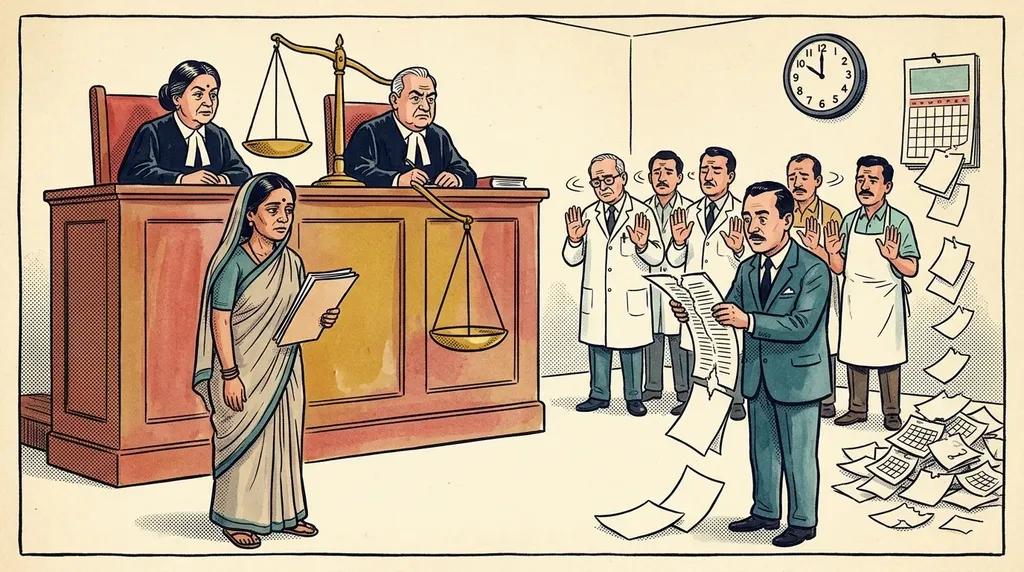
The State Commission looked at the report the refusal rested on and found it full of contradictions and major flaws. As the order quotes it, the report said that people had verbally confirmed a kidney problem for two years and a death caused by it. The same report recorded that three doctors confirmed they had never treated him, three chemists confirmed they had never dispensed any medicine to him, and that no medical history was found in his name. The Commission called the findings built on hearsay and the stance self-contradictory.
Diabetes, kidney disease and the cause of death
The insurer relied on the Supreme Court’s ruling in Satwant Kaur Sandhu that any fact a prudent insurer would weigh is material and must be disclosed. The Commission set against it a line of National Commission decisions, including one that suppression of a pre-existing disease which did not cause the death and has no direct bearing on it does not wholly disentitle the claimant. Its own reasoning was that the pre-existing disease must have a direct nexus to the cause of death, and that this was not shown here.
It found the insurer had made bare assertions with no real proof. There was no word on the record that diabetes or kidney disease contributed to the death, and the insurer had filed neither the past history nor a death summary. Had he died of those illnesses, the Commission said, the treatment records would have shown it. It added that diabetes, a common lifestyle disease, could not alone justify the refusal.
The Commission also counted 213 days between the claim and the repudiation. It noted that, under the IRDA guidelines it cited, claims should be settled within 30 days of the final survey report and in any case within 90 days, and it called the gap a clear deficiency in service.
What the court observed
- A pre-existing disease, to justify rejecting a claim, must have a direct nexus to the cause of death, and that link was not shown here.
- The insurer produced no past history or death summary to show that diabetes or kidney disease contributed to the death.
- The investigation report relied on hearsay and contradicted itself: it said he was treated for kidney disease, and also that no medical history was found in his name.
- Diabetes, a common lifestyle disease, cannot alone be a ground for rejecting a claim.
- The insurer took 213 days to repudiate, which the Commission held to be a deficiency in service.
What the order requires
The appeal was allowed. IndiaFirst must pay ₹20,00,000 with 6% a year from 10 November 2014 (the day of the repudiation) until 24 April 2026 (the day of the judgment), plus ₹1,00,000 for mental agony and harassment and ₹50,000 as litigation costs. The insurer has two months from the judgment to comply. If it does not, a penalty of 9% a year applies to the entire amount until it is paid.
Samadhan Sarathi
If a bank or group loan cover claim has been rejected, the first reply should put the insurer’s reasons next to the medical records and the cause of death. If you want the whole matter handled, that is Bima Samadhan. If you want to write the first letter yourself, the Letter Kit from Samadhan Sarathi drafts it and you file it yourself.
Our guides: claim rejected, grievance letter, escalation letter, Insurance Ombudsman complaint.
Samadhan Sarathi is a private service. It is not the insurer, IRDAI or the Ombudsman. Every case depends on its own facts.
FAQ
The Delhi State Consumer Disputes Redressal Commission, in First Appeal No. 237 of 2023, on 24 April 2026.
It said the borrower had not disclosed Type 2 diabetes and chronic kidney disease when he joined the group loan cover.
The full ₹20,00,000 sum assured with 6% interest from 10 November 2014 to 24 April 2026, ₹1,00,000 for mental agony and harassment, and ₹50,000 in costs, within two months or a 9% penalty on the entire amount.
Source: Delhi State Consumer Disputes Redressal Commission, First Appeal No. 237 of 2023, decided 24 April 2026. Read from the judgment text in our legal library on 24-Nov-2026.
Last updated: 24 November 2026
Legal Disclaimer
Legal Disclaimer: The information provided in this blog article is for general informational purposes only and does not constitute legal advice. The article covers the case Ms. Sunita Kain v. IndiaFirst Life Insurance Company Ltd. (First Appeal No. 237 of 2023) as adjudicated by the Delhi State Consumer Disputes Redressal Commission on April 24, 2026. The details included, such as the ruling, court observations, and case facts, are based on publicly available records and the court’s final decision. Readers are advised not to rely solely on the information provided herein for any legal decisions. For specific legal advice or concerns regarding consumer rights or insurance claims, it is recommended to consult with a qualified legal professional. The publisher disclaims any liability for any losses or damages resulting from reliance on the content of this article.
Send them this story. It may help with their claim.


Comments